


The Fan Out Query SEO Strategy Explained and Why Your Pages Get Cited Without Ranking
According to the Fan-Out Query SEO Strategy, the theory is, that when a user asks Google AI Overview a question like “best CRM software for startups,” the AI doesn't run a single search. It decomposes the query into multiple sub-searches—”startup CRM pricing,” “best CRM for small teams,” “CRM vs spreadsheet for startups”—and pulls information from pages that rank for those related queries, even if those pages don't rank for the original term.
This is the Fan Out Query SEO Strategy Mechanism, and understanding it is the difference between chasing a single keyword and positioning your content to win across AI search results.
New research from Cyrus Shepard's analysis of AI citation ranking factors reveals that URL accessibility, search rank, fan-out rank, preview control, query-answer match, and intent-format match** have the strongest correlation with AI citations. The fan-out factor alone—how well your page ranks for the sub-queries an AI generates—boosts citation odds by **161%**.
Why Your #1 SERPs Ranking Doesn't Guarantee AI Citations
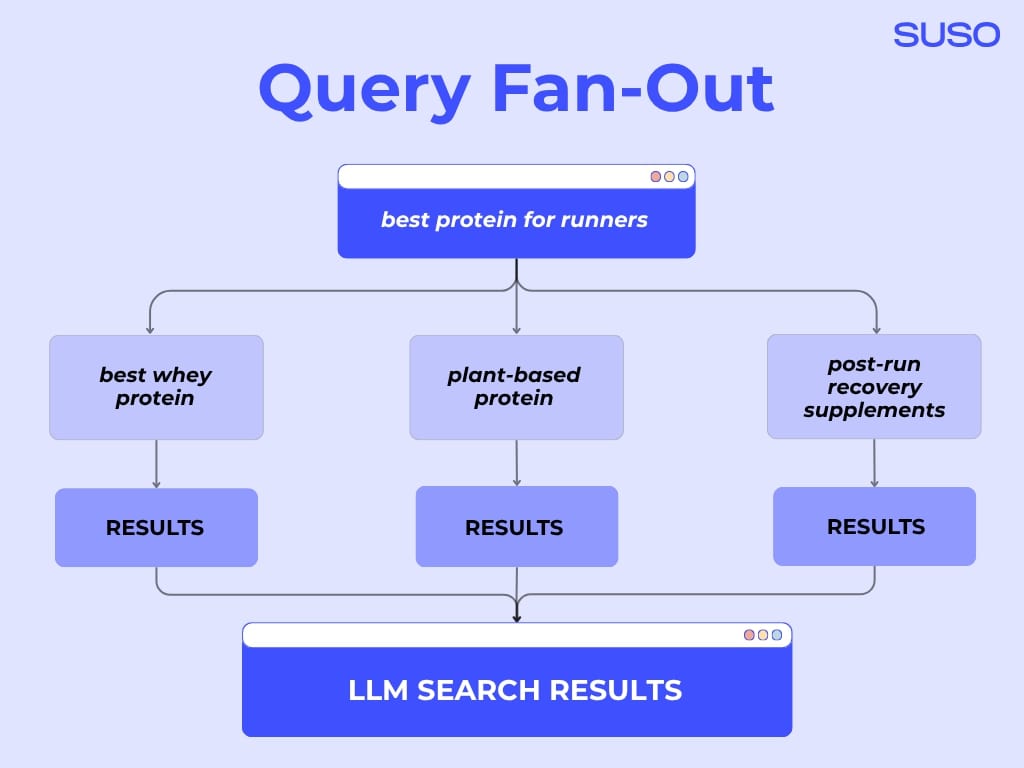 Traditional SEO taught us to optimize for one target keyword. AI search inverts this model.
When AI generates an answer, it performs multiple searches to build a comprehensive response. Research from AirOps shows that **only 15% of pages retrieved by AI systems actually get cited**. The other 85% are pulled but never used.
Pages that get cited aren't always the ones ranking #1 for the main query. They're often the ones that rank for the side queries—sub-topics, related questions, and adjacent search intents—that the AI decomposes the original query into.
A Growth Memo analysis found that **pages covering 26-50% of ChatGPT's fan-out sub-queries get cited more than pages covering 100% of the original query**. Over-optimizing for one keyword leaves you blind to the broader ecosystem of related searches that feed AI responses.
The 161% Citation Boost: How Fan-Out SEO Strategy Works in Practice
Consider a page targeting “project management software.” The fan-out sub-queries might include:
- – “how to choose project management tools”
- – “free vs paid project management”
- – “best project management for remote teams”
- – “project management features checklist”
- – “team collaboration software comparison”
If your page ranks #15 for “project management software” but #3 for “free vs paid project management” and #5 for “best project management for remote teams,” your page may still be pulled into the AI Overview—even above competitors ranking #1 for the main term.
This explains a finding that initially seems counterintuitive: **ChatGPT Search primarily cites lower-ranking pages (position 21+) about 90% of the time**, according to Semrush data. These pages win through fan-out coverage, not head-term dominance.
The Data Behind Fan Out Query SEO Strategy Success
 Position Digital's comprehensive AI SEO statistics analysis reveals critical benchmarks:
- – Only 2% of cited URLs appear across AI Overviews, ChatGPT, and Perplexity. 91% of citations appear only in one AI engine. This means your strategy must target specific platforms.
- –AI Overviews and AI Mode show limited response overlap: just 10.7% of URLs and 16% of domains appear in both.
- – ChatGPT is more likely to reference older content than AIO and Perplexity, with 29% of citations dating back to 2022 or earlier.
Each AI engine has its own fan-out behavior. Optimizing for all of them requires understanding their sub-query generation patterns.
Four Steps to Implement the Fan Out Query SEO Strategy,
1. Map Your Main Fan Out Query SEO Strategy Territory
Use tools like Ahrefs, Semrush, or Surfer SEO to identify:
- – Related questions appearing in “People Also Ask”
- – “Searches related to” suggestions at SERP bottoms
- – Long-tail variations in your keyword research
- – Questions in forum content and Reddit threads mentioning your topic
Document 15-25 sub-queries per main topic. These represent the fan-out territory.
2. Build Topic Clusters, Not Single Pages
Resist the urge to create one comprehensive guide covering everything. Research from Growth Memo shows that **pages with headlines directly answering the question get cited by ChatGPT 41% of the time**. Pages with loosely related headlines drop to 29%.
Instead, create a cluster:
- – One focused page answering the main query with a direct, question-matching headline
- – Supporting pages targeting 3-5 key fan-out sub-queries
- – Internal linking connecting the cluster
The hub page targets the primary query. The spoke pages capture the sub-queries that feed AI responses.
3. Structure Content for the First 30%
44.2% of all LLM citations come from the first 30% of text—the introduction. This is where most extractable snippets are pulled from, per Growth Memo's analysis.
Optimize your intros by:
- – Lead with a direct answer to the target query
- – Include 2-3 key statistics or facts early
- – Use clear, declarative sentences (AI prefers definite language)
- – Place your most important points in the opening paragraph
The “middle” (30-70% of text) accounts for 31.1% of citations, while the conclusion captures 24.7%.
4. Target Intent-Format Match, Not Just Keyword Match
AI systems match queries to answers based on format as much as topic. If someone asks “how to choose,” create decision-making content, not a product comparison. If they ask “best X for Y,” create a curated list.
Research from SE Ranking found that **pages using 120-180 words between headings receive 70% more ChatGPT citations** than pages with sections under 50 words. Adequate spacing between concepts signals completeness.
What Doesn't Work: Dispelling Fan Out Query SEO Strategy Myths
- Schema markup has no impact on AI visibility. Ahrefs' May 2026 analysis found that adding structured data produced no major uplift in citations across AI Overviews, AI Mode, and ChatGPT. Clean HTML works just fine—don't create bot-only markdown or JSON clones.
- Your own domain citations are 6.5x less likely than third-party mentions. Branded mentions in Reddit threads, Quora answers, and independent reviews drive AI citations more than your owned content. The earned media effect extends to AI search.
- AI recommendations are highly inconsistent. SparkToro research shows there's less than a 1 in 100 chance that ChatGPT or Google's AI, asked the same question 100 times, will produce the same brand list twice. Don't over-index on tracking exact citations—focus on building the signals that correlate with citations.
Measuring Fan Out Query SEO Strategy Success
Traditional ranking metrics don't capture the Fan-Out Query SEO Strategy value. Track these instead:
- Sub-query rankings: Are your pages ranking for the fan-out queries in your territory?
- Citation frequency: How often does your content appear in AI Overviews and chat citations?
- Position in AI responses: Are you cited early (first 30%) or late (after the fold)?
- Traffic from AI referrals: Separate AI traffic in your analytics to measure volume and quality
Fan Out Query SEO Strategy Bottom Line
SEO in the AI era isn't about winning one keyword. It's about owning a topic ecosystem.
The Fan Out Query SEO Strategy reframes success from “rank #1 for X” to “rank in the top 10 for X and its 20 related sub-queries.” This dual positioning gives AI systems multiple entry points to cite your content.
Build topic clusters. Optimize intros for early extraction. Match format to query intent. Measure sub-query rankings alongside head-term positions.
The pages getting cited in AI Overviews for the Fan-Out Query SEO Strategy aren't always the ones with the most backlinks or the longest content.
They're often the ones that happen to appear in the AI's Fan-Out Query SEO Strategy search results—and that positioning is largely within your control.
Join Our Mailing List To Learn More About SEO Tactics
 |
This Report was Compiled By:
|
|
|---|
Sources:**
– [Cyrus Shepard / Zyppy Signal – AI Citation Ranking Factors](https://signal.zyppy.com/p/ai-citation-ranking-factors)
– [Growth Memo – The Science of How AI Pays Attention](https://www.growth-memo.com/p/the-science-of-how-ai-pays-attention)
– [Growth Memo – Shorter Focused Content Wins in ChatGPT](https://www.growth-memo.com/p/shorter-focused-content-wins-in-chatgpt)
– [Position Digital – 150+ AI SEO Statistics for 2026](https://www.position.digital/blog/ai-seo-statistics/)
– [AirOps – From Retrieved to Cited: How Commercial Content Earns Citations](https://www.airops.com/report/from-retrieved-to-cited-how-commercial-content-earns-citations-in-ai-search)
– [SE Ranking – How to Optimize for ChatGPT](https://seranking.com/blog/how-to-optimize-for-chatgpt/)
– [SparkToro – AI Recommendations Are Highly Inconsistent](https://sparktoro.com/blog/new-research-ais-are-highly-inconsistent-when-recommending-brands-or-products-marketers-should-take-care-when-tracking-ai-visibility/)
– [Ahrefs – Schema Has No Impact on AI Visibility](https://ahrefs.com/blog/schema-ai-citations/)
– [Ahrefs – Top 10 Most Cited Domains in AI Assistants](https://ahrefs.com/blog/top-10-most-cited-domains-ai-assistants/)
– [Koanthic – AI Overview Citations: 76% Link to Top 10 Rankings](https://koanthic.com/en/ai-overview-citations-76-link-to-top-10-rankings/)